

Fundamentals Of Unani Medicine
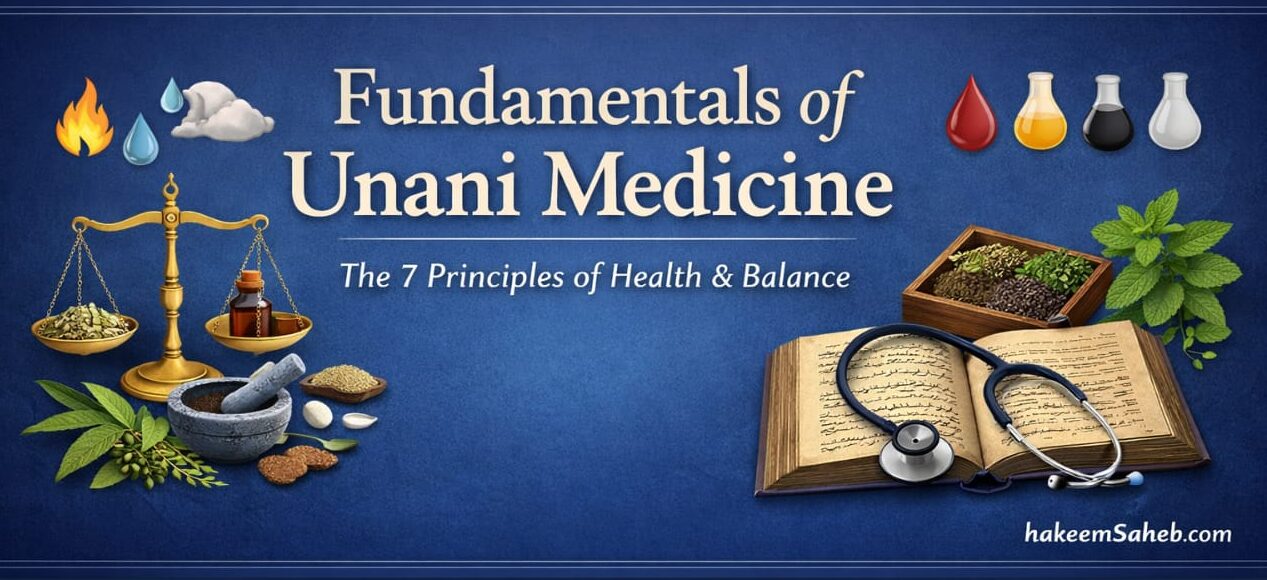
FUNDAMENTALS OF UNANI MEDICINE
According to Unani literature, Tabiyat is the supreme controller of the body. It creates a healthy internal environment and prepares the body to fight diseases. Tabiyat may be defined as the sum total of an individual’s structural, functional, and psychological characteristics. A strong Tabiyat prevents disease; if illness occurs, it works to rectify the condition quickly and restore health.
Tabiyat consists of seven factors or components, known as Umoor-e-Tabaiyah. Losing one or more of these components can lead to death. They are: 1. Arkan or Anasir (Elements / Body Elements) 2. Mizaj (Temperament) 3. Akhlat (Humours / Body Fluids) 4. Aaza (Organs) 5. Arwah (Vital Spirit) 6. Quwa (Faculties or Powers) 7. Afaal (Functions)
Concept of Health and Disease
Unani medicine attributes health to the equilibrium of akhlat (humours) in the body, in terms of their proper quality and quantity. Disturbances in this equilibrium lead to disease. Unani literature emphasizes that every disease has an origin or cause (sabab), which may be internal (e.g., ill temperament or structural malformation) or external (e.g., emotions, physical/chemical factors, or microbes). These causes directly or indirectly affect the individual and result in disease. Unani literature also emphasizes factors that help maintain health, known as the six essential factors (Asbab-e-Sitta Zarooriya). These must be balanced in quantity and quality for health; any imbalance can lead to disease. They are: 1. Hawa (Air) 2. Makoolat wa Mashroobat (Foods and Drinks) 3. Harkat wa Sukoon Badni (Bodily Movement and Rest) 4. Harkat wa Sukoon Nafsani (Mental Activity and Rest) 5. Naum wa Yaqza (Sleep and Wakefulness) 6. Ihtibas wa Istifragh (Retention and Evacuation)
Principles of Diagnosis
Diagnosis relies on various methods, including: – Simple methods like inspection, palpation, percussion, and patient history. – Dedicated methods like pulse examination, and analysis of urine and feces. These methods help reach an accurate diagnosis.
Assessment of Mizaj (Temperament)
Unani medicine assesses individuals based on humours, following the humoral theory. It treats the person as a whole, rather than focusing solely on the disease. Temperament (Mizaj) is classified as Damvi, Balghami, Safravi, or Saudavi by evaluating factors such as body complexion, physique, hair growth, habits, and organ function.
Principles and Modes of Treatment
After proper diagnosis, a suitable Usool-e-Ilaj (line of treatment) is selected. Treatment judiciously removes the disease and prevents recurrence.
It is broadly divided into three main modes:
- Ilaj bil Tadbeer (Regimenal Therapy): Involves physical exercises and procedures such as cupping, leeching, massage, Turkish bath, venesection, and purgation.
- Ilaj bil Dawa (Pharmacotherapy): The most common treatment, used when regimenal therapy is insufficient.
- Ilaj bil Yad (Surgical Therapy): Employed when other treatments fail. The ancient Hakeem Abul Qasim Zohravi described numerous surgical instruments and innovative techniques.
